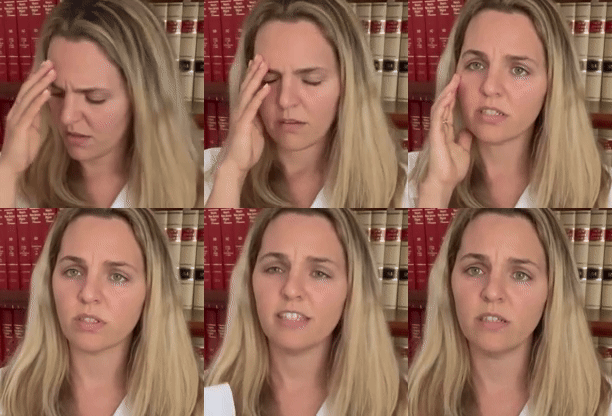

When estates go wrong, families can fracture. As a firm that regularly helps clients at Joshua G. Curtis Law untangle post-death disputes, we see the same pain points again and again: unclear documents, out-of-date beneficiary forms, blended-family tensions, and surprises that show up after a loved one is gone. The good news? Most of these fights are preventable with clear planning, careful titling, and a strategy that anticipates where conflict tends to ignite.
Overview: Why Estate Plans Trigger Family Disputes
Conflicts usually stem from four pressure zones:
- Ambiguity in wills or trusts (vague bequests, missing assets).
- Mismatched paperwork (beneficiary designations that contradict the will or trust).
- Family dynamics (blended families, perceived favoritism, sibling rivalries).
- Process friction (an overwhelmed or conflicted executor, slow communication, or lack of transparency).
Roadmap to Prevention
Below is a step-by-step approach we use at Joshua G. Curtis Law to reduce the risk of litigation and keep families out of court.
1) Build a Clear, Complete, and Current Core Plan
Core documents
- Will that clearly disposes of all property, appoints a capable personal representative (executor), and names guardians if minor children are involved.
- Revocable living trust (where appropriate) to simplify administration, centralize assets, and maintain privacy. Trust funding instructions should be followed to the letter.
- Powers of attorney (financial and health care) to avoid guardianship fights if you become incapacitated.
- Advance health directives to reduce end-of-life conflict.
Make your executor’s job doable
Select someone organized, conflict-averse, and impartial. Provide them with a consolidated asset list (accounts, insurance, deeds, business interests, passwords/digital access instructions) and explain your rationale for any unequal gifts. A well-briefed, neutral fiduciary dramatically reduces friction.
2) Align “Will/Trust World” with “Form-Driven World”
Many of the assets that trigger fights never pass under a will or even a trust—they pass by contract or by title. Make sure this “non-probate” channel isn’t undermining your plan.
- Beneficiary designations on retirement accounts, life insurance, and many brokerage accounts override a will or trust. Review after marriages, divorces, births, deaths, and rollovers.
- TOD/POD registrations (Transfer-on-Death/Payable-on-Death) move assets outside probate and should be coordinated with your overall distribution scheme.
- Real estate: In many states, a Transfer on Death Deed (or “TOD deed”) can pass property outside probate if executed and recorded correctly. Confirm your state’s statute and formalities.
Practice tip: Keep a master list of every account, policy, and deed that passes by beneficiary or title. Re-confirm designations every 1–2 years and after any life event.
3) Reduce Ambiguity in the Documents Themselves
- Use precise bequests: Identify specific items and dollar amounts, and avoid “kitchen-sink” clauses that conflict with earlier gifts.
- Include a residue clause (who gets “everything else”).
- Address common flashpoints:
- Personal property (heirlooms, art, jewelry): create written memoranda incorporated by reference in the will/trust.
- Business interests: add buy-sell terms and a succession plan (who runs it, how it’s valued, how it’s funded).
- Loans and lifetime gifts to children: state whether they’re advances against inheritance or to be forgiven.
4) Consider (and Carefully Draft) a No-Contest Clause
A no-contest (in terrorem) clause can deter weak challenges by penalizing a beneficiary who contests and loses. Enforcement depends on state law and proper “gift-over” drafting; courts in some jurisdictions may still allow contests on good-faith grounds like undue influence or lack of capacity. Have counsel tailor this clause to your state and include a meaningful alternative bequest to make it effective.
5) Get in Front of Digital Assets
Photos, emails, cloud drives, crypto, social accounts, and subscription data can spark unexpected fights. Use your state’s version of the Revised Uniform Fiduciary Access to Digital Assets Act (RUFADAA) to authorize your fiduciaries and follow any “online tools” offered by providers (e.g., Google’s Inactive Account Manager). State law often gives first priority to designations made through the provider’s online tool, then to your estate documents.
6) Use Letters of Instruction (Alongside, Not Instead of, Legal Documents)
A non-binding letter of instruction can explain “why” your plan looks the way it does, list advisors to contact, outline funeral preferences, and give practical guidance to the executor. It’s not a substitute for formal documents, but it can defuse emotions and provide clarity. Keep it updated and stored with your estate plan.
7) Bring the Family into the Process—Strategically
Silence breeds suspicion. Consider a facilitated family meeting—before any crisis—to preview your plan at a high level, introduce the executor/trustee, and set expectations about timelines and communication. In the right families, this meeting dramatically lowers post-death conflict; when emotions run high, a neutral mediator can be invaluable even pre-death.
8) Plan for Mediation if Conflict Arises
If a dispute surfaces, mediation offers speed, privacy, and creative settlements that courts can’t always provide (e.g., rotating possession of heirlooms, structured buyouts, apology statements, or memorial donations). Many probate courts and practitioners favor mediation for will and trust disputes; consider adding a mediation first clause in your plan documents.
9) Protect the Executor/Trustee’s Process
- Inventory and valuation: Create a defensible paper trail of assets, appraisals, and decisions.
- Regular updates: Share status reports and realistic timelines to avoid the “black box” effect.
- Neutral experts: Bring in appraisers, accountants, and—if needed—co-fiduciaries to reduce accusations of bias.
- Know the tax touchpoints: Even when no federal estate tax is due, filing requirements and basis consistency rules may still apply (and state inheritance/estate taxes can vary). Executors should understand what triggers IRS Form 706, closing letters, and portability elections.
10) Special Situations to Anticipate
Blended families & second marriages
Consider QTIP/SLAT or other trust structures to balance a surviving spouse’s lifetime support with children’s eventual inheritances. Be explicit about personal property and the home.
Beneficiaries with vulnerabilities
Use supplemental needs trusts (for disability) or discretionary trusts (for spendthrift risks). Pair inheritances with professional trustees or co-trustees.
Family businesses & real estate
Adopt a buy-sell agreement, valuation mechanism, key-person coverage, and trustee instructions that prevent “frozen” assets from forcing fire-sales to pay taxes/debts.
Out-of-state property
Use ancillary probate planning (e.g., local TOD deed where available, or entity/trust ownership) to avoid multiple probates.
Electronic wills and remote execution
Several states now permit electronic wills under versions of the Uniform Electronic Wills Act. If using e-execution, follow witnessing, notarization, and storage rules precisely—errors here invite contests.
Your 12-Point “Dispute-Proof” Checklist
- Keep a current asset map (accounts, policies, deeds, entities, passwords/online tools).
- Confirm beneficiary designations and TOD/POD titles match your will/trust.
- Fund your revocable trust (retitle assets; record deeds).
- Use specific bequests and an itemized personal-property memorandum.
- Explain unequal gifts in a letter of instruction (and in the document, where appropriate).
- Nominate a capable, neutral executor/trustee—and a backup.
- Build in mediation (and consider a carefully drafted no-contest clause).
- Authorize access to digital assets under RUFADAA and provider online tools.
- Document loans and lifetime gifts with clear “count or forgive” instructions.
- Address business succession, real-estate co-ownership, and buy-sell funding.
- Schedule an annual/biannual review and after every major life event.
- Tell your family the plan—thoughtfully and, if helpful, with a neutral facilitator.
When to Call a Lawyer
If your family situation involves a second marriage, estranged relatives, complex assets (businesses, private investments, crypto), a special-needs beneficiary, or property in multiple states, don’t DIY this. These are precisely the estates that end up in court. An experienced estate-planning and probate attorney can coordinate titling, taxes, and fiduciary duties to keep the peace—and keep your plan enforceable.
Sources & Further Reading
- FINRA: Plan Ahead to Transfer Your Brokerage Account Assets at Death
- U.S. Supreme Court, Egelhoff v. Egelhoff, 532 U.S. 141 (2001)
- Nolo: Payable-on-Death (POD) Accounts—The Basics
- Virginia Code: Transfer on Death Deeds | Uniform Law Commission: Uniform Real Property Transfer on Death Act
- Uniform Law Commission: RUFADAA
- ACTEC: How to Talk with Your Family About Estate Planning
- Advocate Magazine (Sept. 2025): Effective Probate Mediations
- Massachusetts Bar: No-Contest Clauses—How They Work and When They’re Valid
- IRS: Estate Tax FAQs | IRS: About Form 706 & Instructions
- Washington Bar News (2022): Uniform Electronic Wills Act—What Changes
- Nolo: RUFADAA Overview
- Justia: Duties of an Executor
This article is for general information only and does not constitute legal advice. For guidance tailored to your family and your state’s laws, contact Joshua G. Curtis Law.